WILDELIFE GUIDE ALBERTA, CANADA
Alberta’s trails pass through some of the most wildlife-rich terrain in North America. Grizzly bears, black bears, cougars, wolves, elk, moose, and coyotes all share the landscape with hikers across the national and provincial parks, and encounters — from distant sightings to close-range surprises — are a genuine part of hiking here rather than a remote possibility. The vast majority of encounters end without incident. The ones that do not almost always involve a hiker who was unprepared, behaved incorrectly, or both. Before heading out, make sure you are across what to pack for a trip to the Canadian Rockies — wildlife safety equipment starts with the right gear in the right place. This guide covers what to carry, how to behave on the trail, and what to do if an encounter turns serious — for every significant species you are likely to meet.
The Foundation — What to Carry on Every Hike
Before getting into species-specific behaviour, there are three things every hiker in Alberta should carry on every trail, every time, regardless of the length or difficulty of the route.

Bear spray is the most effective deterrent available against bear attack and is more effective than a firearm in close-range encounters according to peer-reviewed research. It is a pressurised canister of capsaicin — the compound that makes chilli peppers hot — that creates a cloud of irritant capable of stopping a charging bear. Carry it in a hip holster on your body, not in your pack. Know how to draw and deploy it before you need to. Check the expiry date before every season — canisters older than four years should be replaced. A can of bear spray that stays in your backpack while a bear closes the distance is functionally useless.
A whistle is the simplest and most underused piece of wildlife safety equipment available. A sharp blast carries further than a human voice, cuts through wind and water noise, and signals your presence on the trail without requiring continuous effort. Clip it to your pack strap where it is accessible without breaking stride.
Knowledge of the trail and current conditions is the third and most overlooked preparation. Parks Canada and Alberta Parks post wildlife activity advisories online and at trailheads for a reason. A trail that was clear yesterday may have had a grizzly feeding in the berry patch above it this morning. Check advisories before you leave, read the trailhead notice boards when you arrive, and take trail closures seriously — they exist because a specific animal is in a specific place and an encounter is considered likely.
Making Noise on the Trail
The single most effective wildlife safety behaviour on the trail is also the simplest — make noise. Bears and other large predators that hear a human approaching almost always move away before any visual contact occurs. The encounters that go wrong most often involve a hiker who surprised an animal at close range, particularly in dense brush, near running water that masks footsteps, or around blind corners on narrow trails.
Talk continuously with your hiking companions. Call out around blind corners and through dense vegetation. Clap your hands in areas of reduced visibility. Bear bells — the small bells attached to packs that jingle with movement — have a role but are less effective than a human voice and should be considered supplementary rather than sufficient. A confident, regular human voice is the most effective warning signal available.
Solo hiking significantly increases encounter risk by removing the natural noise generated by a group. If you are hiking alone in grizzly country, make a deliberate and conscious effort to be louder than feels natural. It will feel performative until the moment it matters.
Bears — Grizzly and Black

Bears are the species most hikers think about first in Alberta, and with good reason. Both grizzly bears and black bears are present across the national and provincial parks in healthy populations, and understanding the difference between them — and the difference in appropriate response — is essential preparation. For a deeper look at where to find them in their natural habitat, our guide to the best spots to see bears in Banff National Park covers the most productive corridors and seasons in detail.
Telling Them Apart
Grizzly bears are larger, with a pronounced muscular shoulder hump, a dished or concave facial profile, and shorter rounded ears. Their claws are long and pale — adapted for digging — and often visible at distance. Colouring ranges from dark brown to blond, frequently with silver-frosted guard hairs on the back and shoulders. Adult males in Banff and Jasper typically weigh between 180 and 270 kg.
Black bears are smaller and more variable in colour than their name implies — in Alberta they appear in black, cinnamon, and occasionally blond phases. They lack the shoulder hump of the grizzly, have a straighter facial profile, and longer, more pointed ears. Their claws are shorter and darker, adapted for climbing rather than digging.
If You See a Bear at Distance
Stop moving. Assess the situation calmly. Speak in a low, firm voice to identify yourself as human. Do not run — running triggers a predatory chase response in bears and you cannot outrun one. Back away slowly while facing the bear if it has noticed you. Give it a clear escape route and time to use it. In most cases the bear will move away on its own once it has identified you as human and non-threatening.
Defensive Bear Behaviour vs. Predatory Bear Behaviour
This distinction is critical and determines your response.
Defensive behaviour occurs when a bear feels threatened, surprised, or is protecting cubs or a food source. A defensive charge is typically preceded by huffing, jaw-popping, swaying of the head, or a bluff charge — the bear stops well short of contact, or makes contact with the intention of neutralising the perceived threat rather than consuming prey. This applies to both grizzlies and black bears in defensive situations.
If a bear makes contact in a defensive charge: play dead. Lie flat on your stomach, legs spread to make it harder for the bear to flip you, hands clasped behind your neck, face down. Remain completely still and silent. The bear’s goal is to eliminate the threat, not to feed — once it believes you are no longer a danger it will disengage. Do not move until you are certain the bear has left the area.
Predatory behaviour is rare but occurs when a bear — almost always a black bear, occasionally a grizzly — approaches a human as a food source rather than as a perceived threat. A predatory bear is calm, quiet, and persistent. It does not bluff charge or vocalise. It follows you, circles you, or approaches steadily and without hesitation. This is the scenario that bear spray is most critically needed for.
If a bear is behaving predatorially: do not play dead. Fight back with everything available — bear spray at close range, followed by aggressive physical resistance targeting the eyes and nose. Make yourself as loud and large as possible. A predatory attack is a hunt and passive submission does not end it.
Bear Spray Deployment
Deploy bear spray when a bear is within approximately 10 to 15 metres and closing. Remove the safety clip, aim slightly downward at the approaching bear, and release a two to three second burst that creates a cloud between you and the animal. Wind direction matters — deploying into a headwind reduces effectiveness significantly. If the bear continues through the spray, deploy a second burst. Most bears disengage on contact with the cloud. After deployment, leave the area immediately — do not wait to observe the bear’s response.
Cougars
Cougars — also called mountain lions or pumas — are present across Alberta’s mountain parks and foothill regions and are among the most rarely seen yet genuinely dangerous animals on the trail. Their rarity in sightings does not reflect rarity in presence. Cougars are ambush predators that detect and observe hikers far more often than hikers are aware of being watched.
Behaviour and Risk
Cougar encounters most often occur at dawn, dusk, and night, when the animals are most active. Trails that pass through dense forest, rocky outcrops, and cliff-edge terrain are higher-risk environments. Solo hikers and children are at elevated risk — cougars assess prey size and vulnerability before deciding whether to pursue. Keeping children close and between adults on the trail is an important precaution in cougar country.
If You Encounter a Cougar
Do not run. Running confirms prey status and triggers pursuit. Make yourself large — raise your arms, open your jacket, stand tall. Make direct eye contact and speak loudly and firmly. Pick up children immediately without bending down or breaking eye contact with the animal. Back away slowly while facing the cougar. If the animal follows, stop retreating and hold your ground.
If a cougar attacks, fight back immediately and aggressively. Target the eyes and nose. Use any available object — trekking poles, a rock, a pack — as a weapon. Unlike with bears, playing dead is never the correct response to a cougar attack. Passive behaviour signals vulnerability and escalates the attack.
Prevention
Make noise on the trail to reduce the chance of a surprise encounter. Hike in groups whenever possible. Keep dogs on a leash — a dog that runs ahead and encounters a cougar will frequently return to its owner at speed, bringing the cougar with it. Report all cougar sightings to Parks Canada or Alberta Parks immediately.
Elk

Elk are the most commonly encountered large animal on trails across Banff, Jasper, and the surrounding foothills — and the one most frequently underestimated. They are large, fast, and unpredictable, and they injure more people in Banff National Park each year than bears do. If this is your first visit to the area, our ultimate Banff travel guide for first-time visitors covers elk behaviour in the townsite alongside everything else you need to know before you arrive.
When Elk Are Most Dangerous
Calving season (May to June) — cows with newborn calves are highly aggressive and will charge without warning to defend their young. A cow elk that pins her ears back and raises the hair on her neck is about to charge. Move away immediately and put a solid barrier — a vehicle, a large tree, a building — between yourself and the animal.
Rut (September to October) — bull elk in rut are testosterone-driven and unpredictable. Bulls that appear calm can charge explosively with almost no warning. The minimum safe distance is 30 metres, and even this is not always sufficient during peak rut. Do not position yourself between two bulls, approach a bull to photograph it, or make sounds that could be interpreted as a challenge.
General Elk Safety
Never approach elk regardless of how calm they appear. Elk in the Banff townsite in particular have become habituated to human presence and appear docile — they are not. Give all elk a minimum of 30 metres of space. If an elk is blocking the trail, wait patiently at distance or find an alternate route. Do not attempt to pass close behind an elk — a kick from a bull elk can be fatal.
Moose
Moose are the largest members of the deer family and are significantly more dangerous than their unhurried appearance suggests. A bull moose in autumn rut or a cow with a calf will charge with little provocation, and at over 500 kg they are capable of inflicting catastrophic injury.
Reading Moose Body Language
A moose that is about to charge will typically lower its head, lay its ears back, raise the hair on its shoulders and hump, and may lick its lips repeatedly. These are serious warning signals — move away immediately and put a large tree or solid object between yourself and the animal.
Unlike bears, moose do not pursue at length. If a moose charges, run and put a barrier between yourself and the animal. The charge is typically a bluff intended to drive you off, and the moose will usually stop once you have retreated sufficiently. Unlike with bears, running is a reasonable immediate response to a moose charge.
Where Moose Are Most Common
Moose favour wetlands, lakeshores, river valleys, and willowy shrubland. The Maligne Valley in Jasper, the Vermilion Lakes area near Banff, and the boreal transition zones of northern Alberta are particularly productive moose habitat. For a comprehensive overview of the best wildlife viewing locations across the province, the guide to where to see wildlife in Alberta covers the full range of species and habitats in detail. Exercise extra caution in moose habitat, particularly in poor visibility and low light.
Wolves
Wolf encounters on hiking trails are rare but increasing as Alberta’s wolf populations recover and expand. Wolves are generally wary of humans but habituated individuals — those that have lost their natural fear of people through repeated exposure — can behave unpredictably.
If you encounter a wolf on the trail, make yourself large, make direct eye contact, and speak loudly and firmly. Do not run. Back away slowly while maintaining your presence. If a wolf follows persistently, stop, face it, and increase your aggressive display — shout, wave your arms, throw objects if necessary. Report all wolf encounters to Parks Canada or Alberta Parks. A wolf that does not retreat from a confident human display should be reported as a priority safety concern.
Keep dogs on a leash in wolf country. Wolves are territorial and will engage dogs, particularly off-leash dogs that enter their range.
Coyotes
Coyotes are present across virtually all Alberta hiking terrain and are the wildlife species visitors are most likely to encounter up close. In most cases a coyote sighting is a pleasant wildlife moment rather than a safety concern. The risk arises with habituated coyotes — individuals that have been fed, intentionally or inadvertently, and have lost their natural wariness of humans.
A habituated coyote that approaches closely, follows hikers, or displays no flight response at human presence should be treated as a potential safety concern, particularly around children and small dogs. Make loud noise, wave your arms, and advance toward the animal to reinforce its natural wariness. Never feed coyotes under any circumstances. Report persistent or aggressive coyote behaviour to park authorities.
General Rules for Every Hike
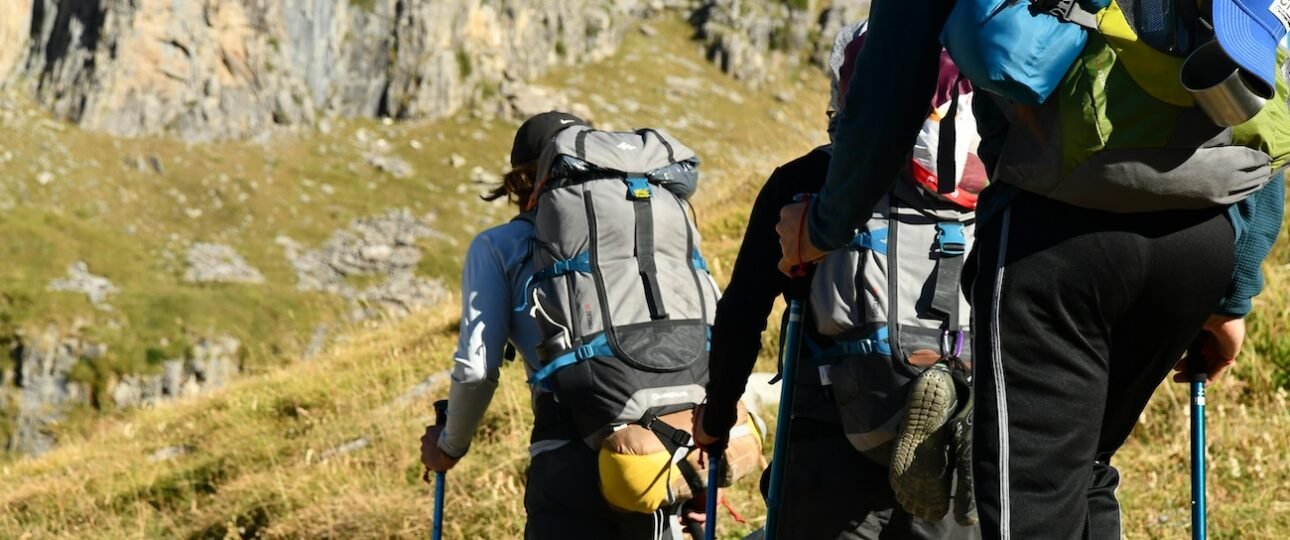
Hike in groups. Groups of four or more have a dramatically lower encounter risk than solo hikers or pairs. If you must hike alone, be significantly louder and more alert than you would be in a group.
Keep dogs on a leash. Off-leash dogs are prohibited on most trails in Alberta’s national and provincial parks for good reason. An off-leash dog that encounters wildlife will frequently escalate a situation that a leashed dog would not.
Never feed wildlife. Intentional feeding is illegal in national parks and carries significant fines. Unintentional feeding — through improperly stored food, accessible garbage, or dropped trail snacks — is equally damaging. A food-conditioned animal almost always ends its life being destroyed by wildlife managers. Your behaviour directly determines the survival of the animals you encounter.
Store food properly. At designated campsites use bear-proof food lockers or approved bear canisters. On day hikes keep food in your pack until you are ready to eat, and never leave a pack unattended on the trail.
Get a Parks Canada pass before you go. If you are planning multiple hikes across Banff, Jasper, or any of Alberta’s national parks, read our guide on how to get a Canadian National Parks pass and whether it is worth it before you travel — it covers costs, coverage, and exactly where to buy one.
Know the emergency number. Parks Canada emergency dispatch: 1-888-WARDENS (1-888-927-3367). Alberta Parks emergency: 310-0000. Programme these into your phone before you leave the trailhead.
Trail Etiquette Around Wildlife
When an animal is visible on or near the trail, the collective behaviour of everyone present matters enormously. Crowding around a bear or elk for photographs, making sudden movements, or getting between an animal and its escape route creates danger for everyone — including the animal.
Maintain minimum distances at all times: 100 metres for bears and wolves, 30 metres for elk, moose, cougars, and coyotes. Use binoculars and telephoto lenses. Do not use food or sound to attract animals toward you. If a warden or Parks Canada staff member is managing a wildlife situation on the trail, follow their instructions immediately and without negotiation.
When to Be Most Alert
Dawn and dusk are the periods of highest wildlife activity across most species. Schedule early starts and late returns with this in mind and adjust your alertness accordingly.
Dense bush and creek crossings reduce visibility and mask sound in both directions — you cannot hear the bear and the bear cannot hear you. Increase noise output significantly in these environments.
Berry season (late July through September) concentrates bears in predictable locations as they enter hyperphagia. Check Parks Canada advisories for current berry patch locations and bear activity before hiking in this period.
Spring (April through June) brings hungry bears emerging from dens, cow elk with newborn calves, and generally high animal activity across the valley systems. Trail closures are more common in spring than at any other time of year and should always be respected.
FAQ
Is bear spray really necessary or is it just for nervous hikers?
Bear spray is necessary for every hiker on every trail in bear country, regardless of experience level. Research consistently shows it is more effective than firearms in close-range bear encounters. The question is not whether to carry it but whether you know how to use it — practise the draw before you need it and keep it on your body, not in your pack.
What should I do if I surprise a bear at close range?
Stay calm and do not run. Speak in a low, firm voice to identify yourself as human. Give the bear space and a clear escape route. Have your bear spray drawn and ready. If the bear charges defensively, deploy spray when it is within 10 to 15 metres. If it makes contact, play dead — flat on your stomach, hands over your neck, legs spread. Remain completely still until the bear has left the area.
Is it safe to hike alone in Alberta?
Solo hiking is significantly higher risk than group hiking in wildlife-rich terrain. If you hike alone, carry bear spray without exception, make significantly more noise than you would in a group, tell someone your route and expected return time, and check in when you are back. Many serious incidents in Alberta’s mountain parks have involved solo hikers. This does not mean you should not hike alone — it means you should prepare differently when you do.
Are bears more dangerous in spring or autumn?
Both seasons carry elevated risk for different reasons. Spring brings hungry bears emerging from dens moving through lower-elevation terrain where hikers are concentrated. Autumn brings hyperphagia — bears feeding intensively before denning — which makes them highly focused on food and potentially more likely to defend a food source aggressively. Check current Parks Canada advisories before hiking in either season.
What is the difference between a defensive and predatory bear attack?
A defensive attack is the bear’s response to feeling threatened, surprised, or cornered — it is trying to neutralise a perceived threat. Play dead in a defensive attack. A predatory attack occurs when a bear approaches you as a food source — it is calm, quiet, and persistent rather than explosive and preceded by warning signals. Fight back aggressively in a predatory attack. Never play dead when a bear is behaving predatorially.
Do I need bear spray on short or popular trails?
Yes. Trail length and popularity do not eliminate wildlife risk. Some of the most significant bear encounters in Banff have occurred on short, heavily used trails like Johnston Canyon. Bears do not avoid popular trails — they use the most productive habitat regardless of human traffic. Carry bear spray on every hike.
What should I do if I see a wolf?
Make yourself large, maintain direct eye contact, and speak loudly and firmly. Do not run. Back away slowly while maintaining your display. If the wolf follows persistently, stop and increase your aggressive presence — shout, wave arms, throw objects. Report the encounter to Parks Canada or Alberta Parks immediately. A wolf that does not respond to a confident human display is a priority safety concern.
Are children at higher risk on Alberta trails?
Children are at elevated risk around cougars specifically, as their smaller size and movement patterns more closely resemble prey. Keep children between adults on the trail, within arm’s reach in areas of reduced visibility, and never allow them to run ahead around blind corners. Children should also carry their own whistle. Adjust trail selection to avoid high-cougar-activity areas when hiking with young children.