Last updated: November 23, 2026
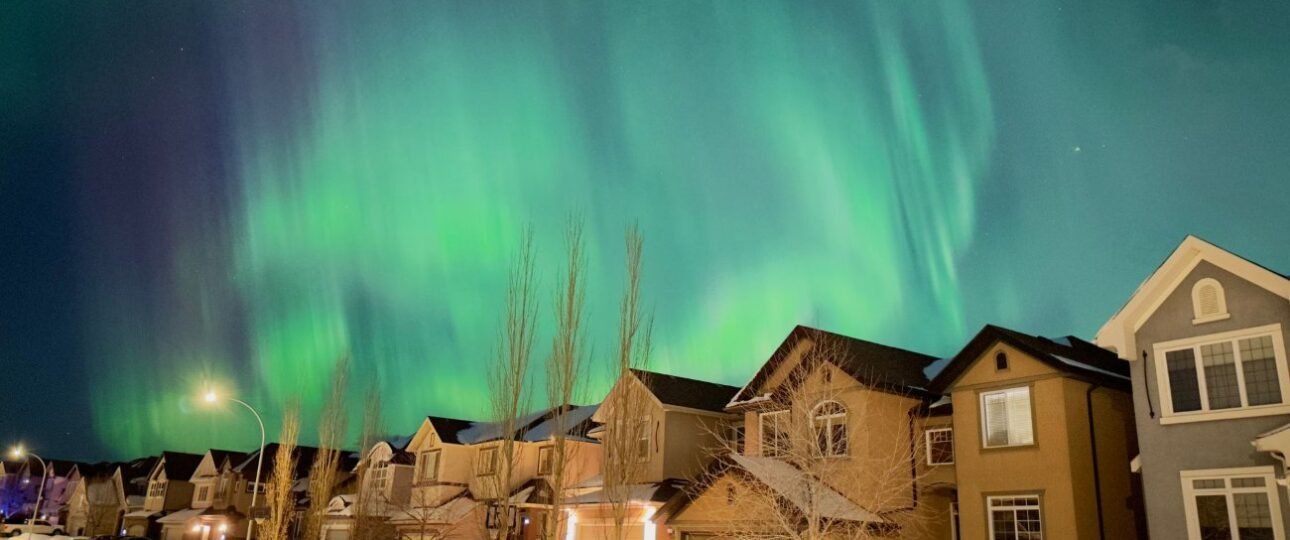
Seeing the northern lights in Alberta is easier than most people think. The province sits far enough north for regular aurora displays, it has some of the darkest skies on the continent, and long winter nights give you hours of viewing time. You don’t even have to fly north: the photo above was taken in a Calgary neighbourhood.
This guide covers the 9 best places to see the aurora, the best months and hours, how to read an aurora forecast, and simple tips for getting a great photo with your phone.
In this guide
When to See the Northern Lights in Alberta
The aurora happens all year, but you can only see it when the sky is dark. That’s why the season for the northern lights in Alberta runs from late August to April, with the long nights from October to March giving the best chances, according to Travel Alberta.
| Month | Darkness | Aurora odds |
|---|---|---|
| 🍂 September | Nights getting longer, mild weather | Very good; autumn equinox often brings active nights |
| 🌙 October–November | Long nights | Very good |
| ❄️ December–January | Longest nights, very cold | Good; more hours of darkness, but more cloud in some areas |
| 🌨️ February–March | Long nights, clearer skies | Very good; spring equinox often active |
| ☀️ May–July | Very short nights in the north | Poor, especially in northern Alberta |
The most active time is usually from about 10 pm to 2 am. Alberta moved to year-round daylight time in November 2026, so the darkest part of the night now falls about an hour later on the clock than it used to. Our page on Alberta sunrise and sunset times shows when it gets dark in each city.
Is 2026-27 a good season? Yes. The sun’s activity peaked in late 2024 and is now in its declining phase, but space-weather scientists point out that this phase often brings some of the strongest geomagnetic storms of the whole cycle.
The 9 Best Places to See the Northern Lights in Alberta
Alberta has several official dark sky preserves, where outdoor lighting is limited to protect the night sky. These are the best places for the northern lights in Alberta, from north to south.
1. Wood Buffalo National Park
The world’s largest dark sky preserve sits on the border with the Northwest Territories, right under the main aurora zone. On active nights the lights can fill the whole sky. It’s remote, so plan a trip through Fort Smith or Fort Chipewyan, or visit during the park’s Dark Sky Festival in late summer.
2. Peace River Country
Northwestern Alberta, home to the aptly named County of Northern Lights, gets aurora displays far more often than the south. Wide, flat farmland means you can see right down to the northern horizon, and towns are small enough that you only need to drive a few minutes out to find darkness.
3. Lakeland Provincial Park
Near Lac La Biche, about 2.5 hours northeast of Edmonton, this dark sky preserve is all lakes and boreal forest. Lakes make the best foregrounds, because the aurora reflects off open water in autumn and the frozen surfaces give clear, open views in winter.
4. Elk Island National Park
Just 45 minutes east of Edmonton, Elk Island is part of the Beaver Hills Dark Sky Preserve and is the easiest dark sky trip from the capital. Head to Astotin Lake, where you can watch the lights from the shore. You may even hear bison nearby. For more bison country, see our guide to the Wainwright bison herd.
5. Jasper Dark Sky Preserve
Jasper was named a dark sky preserve in 2011 and is one of the largest dark sky preserves in the world. Pyramid Lake, Lake Annette and the open meadows along the Athabasca River all give wide views to the north. Our Jasper National Park travel guide can help you plan the rest of your stay.
6. Abraham Lake
Abraham Lake on the David Thompson Highway isn’t an official preserve, but there’s almost no light for miles. In winter, the aurora shines over the lake’s famous frozen methane bubbles. Read our guide to the Abraham Lake ice bubbles before you go.
7. Lake Minnewanka, Banff
Just 15 minutes from the town of Banff, Lake Minnewanka has wide-open views over the water, making it one of the best spots for the northern lights in Alberta’s mountain parks. Vermilion Lakes is a good second choice. Banff Sunshine Village runs an aurora webcam that lets you check the sky before you head out.
8. Cypress Hills Interprovincial Park
Straddling the Saskatchewan border south-east of Medicine Hat, Cypress Hills is a dark sky preserve on a high plateau above the prairie. The Alberta side, around Elkwater, is less than an hour from Medicine Hat. Southern Alberta needs stronger storms to see the aurora, so watch the alerts.
9. Waterton Lakes National Park
Waterton is part of the Waterton-Glacier International Dark Sky Park. The aurora is rarer this far south, but on strong nights the lights appear over the lakes and peaks, and the Milky Way is spectacular even when the aurora doesn’t show.
Seeing the Aurora from Calgary and Edmonton
You can see the northern lights in Alberta’s big cities during strong storms, but city lights wash out fainter displays. Edmonton sees more displays than Calgary because it’s nearly 300 km further north.
- Calgary: drive north or east past the city limits, where the prairie opens up and the northern horizon is dark. Inside the city, high spots with a view to the north, such as Nose Hill Park, work on strong nights.
- Edmonton: head out to the countryside around Elk Island or north of the city along rural roads. Strathcona Wilderness Centre is another popular spot.
- Look north. The aurora usually starts low on the northern horizon, then climbs higher during strong displays.
How to Read an Aurora Forecast
You don’t need to understand space weather to catch the northern lights in Alberta. Three checks are enough.
- Aurora activity. Sign up for free email alerts from AuroraWatch, run by the University of Alberta. It measures the earth’s magnetic field right here in Alberta and sends colour-coded alerts when the aurora is likely.
- Clouds. Even a great storm is invisible under cloud. Check Environment Canada’s cloud forecast and look for clear skies after dark.
- The moon. A full moon brightens the sky and hides weaker displays. The week around a new moon is best.
As a rough guide, a moderate storm (often shown as Kp 4 or 5 on aurora apps) is usually enough for the Edmonton area and central Alberta, while southern Alberta often needs Kp 5 or higher. In the far north, even quiet nights can bring a show.
Photo Tips for the Northern Lights
When you photograph the northern lights in Alberta, your camera often sees the aurora better than your eyes do, picking up greens, pinks and purples that look grey in the dark. Travel Alberta suggests starting with a 15-second exposure and a wide-open aperture on a DSLR, then raising the ISO until the photo gets grainy.
- Use a tripod. Long exposures blur if the camera moves at all.
- Focus manually on a bright star. Autofocus struggles in the dark.
- On a phone, use night mode and rest the phone on something solid.
- Add a foreground. A lake, a tree line or a grain elevator makes the shot.
- Keep batteries warm. Cold drains them fast, so carry spares in an inside pocket.
What to Bring for an Aurora Night
Hunting for the northern lights in Alberta means standing still outside for hours, often at -20°C or colder. Our guide to how cold Alberta really gets explains what to expect.
- Insulated boots, a parka, warm mitts and a toque
- A thermos of something hot and a few snacks
- A headlamp with a red light, so you keep your night vision
- A folding chair or a blanket
- A full tank of gas and winter tires; rural roads can be quiet and icy
Want to stay somewhere cozy? Several Alberta glamping domes and cabins have clear roofs for sky-watching from bed. See our guide to glamping in Alberta for ideas. For more on dark sky parks and events, Travel Alberta has a helpful northern lights and stargazing page.
FAQs
When is the best time to see the northern lights in Alberta?
Travel Alberta says the long, dark nights from October to March give the best chances. September and March are also strong months, and the most active hours are usually from late evening to about 2 am.
Can you see the northern lights from Calgary or Edmonton?
Yes, during strong displays. You’ll see far more on the edge of the city or in the countryside, away from street lights. Edmonton gets more displays than Calgary because it sits further north.
Where is the best place to see the northern lights in Alberta?
For the best odds, go north to Wood Buffalo National Park or the Peace River Country. Closer to the cities, Elk Island National Park near Edmonton and the Jasper Dark Sky Preserve are the most popular spots.
Is 2026-27 a good year for the northern lights?
Yes. The sun passed the peak of its 11-year cycle in late 2024, but scientists note that the declining phase often brings strong geomagnetic storms. Displays should stay frequent through the 2026-27 winter.
How do I know if the northern lights will be out tonight?
Sign up for free alerts from AuroraWatch, run by the University of Alberta, and check the cloud forecast. A strong alert plus a clear sky and little moonlight is the best combination.
Can I photograph the northern lights with my phone?
Yes. Use night mode, put the phone on something steady or a small tripod, and hold still for the full exposure. Phone cameras often pick up colours your eyes can barely see.