Wildlife Guide · Alberta, Canada
Where to See Wildlife
in Alberta
A complete guide — bears, bison, wolves, elk, and much more
🐂 Bison
🐺 Wolves
🦌 Elk & Moose
🐐 Mountain Goats
🦅 Raptors
Alberta is one of the finest wildlife viewing destinations in North America — a province where five national parks, over 460 provincial parks, and vast tracts of protected wilderness support nearly 600 species of animals. Grizzly bears, grey wolves, wood bison, woodland caribou, bighorn sheep, moose, elk, mountain goats, cougars, wolverines, and lynx all call Alberta home. With the right knowledge of where and when to look, encounters with most of them are achievable on a standard trip.
This guide covers the best wildlife viewing locations in Alberta by region, a species-by-species quick reference, the optimal season for each animal, and the practical information needed to make every outing count.
⚠ Wildlife Safety — Rules You Must Know Before You Go
- Maintain at least 100 metres from bears, wolves, and cougars. At least 30 metres from all other wildlife.
- Never feed wildlife — it habituates animals to humans and is illegal in national parks. Habituated animals are frequently destroyed.
- Carry bear spray and know how to use it before entering wilderness areas. Keep it accessible on your hip, not buried in your pack.
- Make noise on trails to avoid surprising wildlife — most dangerous encounters happen at close range without warning.
- Observe from your vehicle whenever possible — a car is a safe and effective hide and allows much closer observation without disturbing the animal.
- If you cause an animal to move, change behaviour, or stop feeding, you are too close. Back away slowly.
The Canadian Rockies — Banff & Jasper
The most species-rich and most accessible wildlife viewing in Alberta — iconic large mammals in a setting that makes every encounter extraordinary.
Banff National Park — Bow Valley Parkway (Hwy 1A)
The single finest wildlife corridor in Banff · Dawn and dusk drives · 58 km of prime habitat
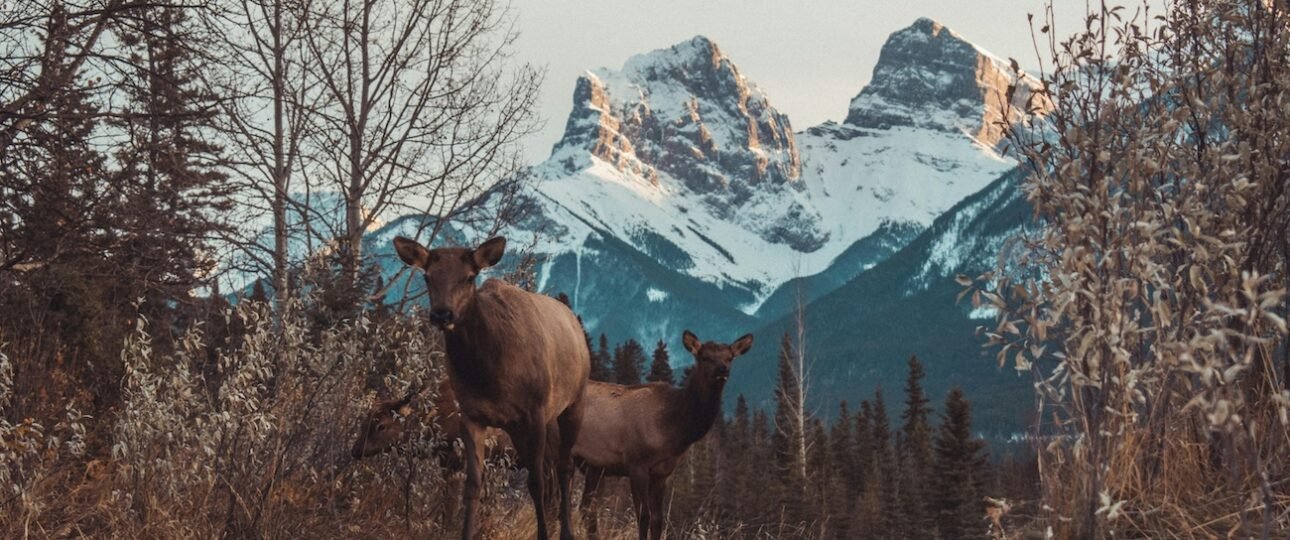
The Bow Valley Parkway (Highway 1A) is the finest single wildlife viewing route in Banff National Park and one of the best in Canada. Running parallel to the Trans-Canada Highway between Banff townsite and Lake Louise, the 58-kilometre route passes through prime wildlife habitat at a slower pace with far less traffic. Dawn and dusk drives along the 1A produce reliable elk, deer, black bear, and occasionally wolf and cougar sightings. The stretch between Johnston Canyon and Castle Mountain is particularly productive for bears in berry season (August–September). Parks Canada periodically closes sections of the road to protect denning predators — these closures are themselves a signal to scan the adjacent hillsides carefully.
Elk (very common), white-tailed deer, mule deer, black bear, grizzly bear, moose, coyote, wolf (rare), cougar (very rare), beaver, porcupine, great horned owl
- Drive slowly at dawn and dusk — this doubles your sighting probability compared to midday
- Pull over and wait patiently when you spot activity — wildlife rarely stays still but often returns to the same area
- The Johnston Canyon to Castle Mountain section is most productive for bears in berry season (August–September)
- Parks Canada wildlife reports at pc.gc.ca are updated regularly — check before your drive
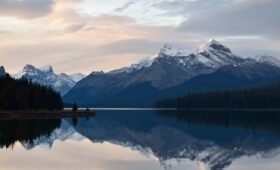
Jasper National Park — Maligne Lake Road & Icefields Parkway
53 mammal species · 260+ bird species · Best grizzly and wolf viewing in the Rockies
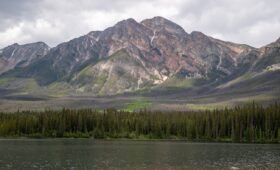
Jasper National Park offers more reliable large predator sightings than Banff, partly due to lower visitor pressure and a larger park footprint. The Maligne Lake Road is the most productive single corridor — moose appear regularly in the marshy sections near the lake, while elk, bighorn sheep, and occasionally bears and wolves are seen along the full length. The Icefields Parkway (Highway 93) between Jasper and the Columbia Icefield is the other key corridor: the Goats and Glaciers viewpoint (Km 125 from Jasper) lives up to its name for mountain goat sightings, and bighorn sheep congregate at mineral licks throughout. September and October elk rut at the Jasper townsite meadows is one of the most spectacular wildlife events in Canada.
Grizzly bear, black bear, moose (very common on Maligne Rd), elk, bighorn sheep, mountain goat, grey wolf, woodland caribou (rare), wolverine (very rare), golden eagle, bald eagle
- September elk rut at Jasper townsite meadows — hundreds of elk gather, bulls bugle, and the experience is extraordinary
- Maligne Lake Road: scan the marshy sections near km 10–20 carefully at dawn for moose
- Icefields Parkway: Goats and Glaciers viewpoint (km 125) reliably delivers mountain goat sightings year-round
- Evening Wildlife Safari tours achieve wildlife sightings on 95% of trips — a worthwhile option for time-limited visitors
The Canadian Badlands
A completely different wildlife experience — prairie raptors, small carnivores, and the surreal hoodoo landscape of the Red Deer River valley.
Dinosaur Provincial Park & Drumheller Badlands
UNESCO World Heritage Site · Prairie raptors · Coyotes · Burrowing owls · Red foxes
The badlands of southeastern Alberta deliver a completely different wildlife experience from the Rockies — dramatic but intimate, with an emphasis on smaller carnivores, prairie birds of prey, and the atmosphere of the coulee landscape. Coyotes are abundant and visible at most hours. Red foxes, badgers, pronghorn antelope, and mule deer are regularly encountered. Burrowing owls — small, endangered, and endearing — nest in prairie dog colonies in the area. Prairie rattlesnakes are present in Dinosaur Provincial Park and should be treated with respect on rocky sections of trail. Golden eagles, ferruginous hawks, and Swainson’s hawks soar overhead throughout summer.
Coyote (very common), red fox, mule deer, pronghorn antelope, badger, burrowing owl, golden eagle, ferruginous hawk, prairie rattlesnake (on rocky ground), white-tailed jackrabbit
- Evening is best — coyotes and foxes most active as the coulee light turns golden before dusk
- Burrowing owl colonies near the entrance road — look for ground-level activity at short posts or holes
- Prairie rattlesnakes are shy but present — watch where you step off-trail on rocky ledges and outcrops
- Carry binoculars — the open coulee landscape gives superb long-distance raptor viewing
Near Edmonton — Elk Island National Park
The most reliable bison viewing in Canada — 700+ wood and plains bison within 45 minutes of Edmonton.
Elk Island National Park
700+ bison · Dark Sky Preserve · 250 bird species · Year-round guaranteed wildlife
Elk Island National Park is the finest place in Canada to observe free-roaming bison at close range with near certainty. The park maintains herds of both plains bison and wood bison — separated by a fence — totalling over 700 animals. Bison frequently appear on and beside the park roads, particularly through the aspen parkland sections. The park also supports elk, white-tailed deer, moose, coyotes, beavers, and an extraordinary diversity of birds. As a Beaver Hills Dark Sky Preserve, Elk Island doubles as one of the best stargazing locations near Edmonton — making it an ideal two-experience day trip.
Plains bison (very reliable), wood bison, elk, moose, white-tailed deer, beaver, coyote, great blue heron, trumpeter swan, 250+ bird species
- Drive slowly along the main park road in the morning — bison are frequently roadside and sometimes on the road itself
- The Bison Backstage experience provides a guided tour of the Plains Bison Handling Facility with expert conservation commentary
- Stay for stargazing after dark — Beaver Hills Dark Sky Preserve status makes this one of the best dark sky sites near Edmonton
- Bison are present and visible in all four seasons — winter visits with snow-covered bison herds are particularly dramatic
Northern Alberta — Wood Buffalo National Park
The second-largest national park in the world — 5,000+ free-roaming wood bison, the only wild whooping crane nesting site on earth, and wilderness on a scale found nowhere else in Canada.
Wood Buffalo National Park
World’s largest free-roaming bison herd · World’s only wild whooping crane nesting site · UNESCO World Heritage
Wood Buffalo National Park is an experience without parallel in Alberta — a 44,807-square-kilometre park stretching from northern Alberta into the Northwest Territories. It is the world’s largest dark sky preserve, a UNESCO World Heritage Site, and home to the world’s largest free-roaming herd of wood bison at over 5,000 animals. Most significantly, it is the only natural nesting site in the world for the endangered whooping crane — a species once reduced to just 21 individuals and now slowly recovering. Timber wolves, black bears, moose, bald eagles, and spotted owls complete an extraordinary species list across vast boreal, delta, and wetland ecosystems.
Wood bison (world’s largest free-roaming herd), whooping crane (endangered, nests here May–July), timber wolf, moose, black bear, bald eagle, spotted owl, beaver, peregrine falcon
- Whooping crane nesting season is May–July — observe from distance and follow all park regulations strictly
- Bison are most visible along the main park roads, particularly the Peace-Athabasca Delta area
- Book accommodation in Fort Smith or Fort Chipewyan well in advance — options are very limited
- Allow at least 2–3 days — the scale of this park (comparable to Switzerland) requires time
- Winter visits offer aurora borealis viewing alongside wolf tracking — a remarkable combination
Species Quick Reference — Where & When
| Species | Best Location(s) | Best Season | Viewing tip |
|---|---|---|---|
| 🐻 Grizzly Bear | Jasper NP, Banff 1A, Icefields Pkwy | Apr – Oct | Dawn/dusk drives. Berry season (Aug–Sept) is peak. |
| 🐻 Black Bear | Banff 1A, Kananaskis, Jasper | Apr – Oct | More common than grizzlies. Watch forested edges at dawn. |
| 🦌 Elk | Jasper townsite, Banff valley, Kananaskis | Year-round | September rut in Jasper is unmissable. Bulls bugle at dawn. |
| 🦌 Moose | Maligne Lake Rd, Elk Island, Kananaskis | Year-round | Marshy areas at dawn. Often roadside on Maligne Lake Road. |
| 🐂 Plains Bison | Elk Island National Park | Year-round | 700+ animals. Extremely reliable roadside sightings. |
| 🐂 Wood Bison | Wood Buffalo NP, Elk Island (south herd) | Year-round | World’s largest free-roaming herd at Wood Buffalo. |
| 🐺 Grey Wolf | Jasper backcountry, Hwy 16 west | Year-round | Dawn/dusk. Rare but possible — scan open valley floors. |
| 🐐 Mountain Goat | Icefields Pkwy, Goats & Glaciers viewpoint | Year-round | Look up — they prefer steep cliff faces above treeline. |
| 🐏 Bighorn Sheep | Icefields Pkwy mineral licks, Jasper area | Year-round | Mineral licks at roadsides attract them close and reliably. |
| 🕊 Whooping Crane | Wood Buffalo NP (only nesting site) | May – Jul | Endangered. Observe from strict distance only. |
| 🦅 Golden Eagle | Badlands, foothills, Rockies ridges | Year-round | Scan ridge lines and thermal columns in afternoon sun. |
| 🦊 Coyote | Banff townsite, badlands, prairies | Year-round | Most active dawn and dusk. Often seen in pairs or small groups. |
When to Go — Seasonal Wildlife Calendar
🌱 Spring · April – May
Bears emerging from dens, calving elk and moose, major migratory bird arrivals
Grizzly bears with cubs visible on south-facing slopes. Moose calves in marshy areas. Huge migratory bird diversity. Very few tourists on park roads — a genuinely peaceful time to visit.
☀ Summer · June – August
All species active, bears in berry season, mountain goats with kids
Busiest season for tourism — go before 8am for best wildlife and least traffic. Berry season from late July brings bears to roadsides predictably. Wildlife safaris at their busiest.
🍂 Autumn · September – October
Elk rut (unmissable), golden eagles migrating, bears hyperphagia
September is arguably the single best wildlife viewing month in Alberta. Cool temperatures, spectacular light, bull elk bugling at dawn, and bears feeding intensively before denning. Fewer crowds than summer.
❄ Winter · November – March
Wolf pack activity, bison in snow, elk herding, aurora borealis
Wolf packs most active and trackable in snow. Bison at Elk Island are dramatic against winter white. Minimal tourist presence. Aurora borealis visible in northern Alberta. A genuinely underrated time to visit.
Seeing wildlife in Alberta is not a matter of luck — it is a matter of timing, patience, and knowing where to be at the right hour. The animals are there. The province has protected enough wilderness that encountering them is not exceptional; it is simply a matter of going early, moving slowly, and looking properly. That is a rare thing to be able to say about anywhere in the world.
Keep your distance · Keep your camera ready · Alberta Wildlife