Viewpoint Guide · Banff National Park
BEST VIEWPOINTS
IN BANFF
Ten vistas you absolutely cannot miss — from the summit of Sulphur Mountain to the shores of Moraine Lake
10 viewpoints · Free to gondola access · All seasons
Banff National Park is built around one of the most extraordinary concentrations of mountain scenery on earth — and unlike many wilderness destinations, a significant proportion of its finest views are accessible without technical skill, strenuous hiking, or expensive equipment. The park’s geology has created a landscape of dramatic peaks, glacier-carved valleys, and turquoise lakes that deliver a world-class photograph from almost every angle. The challenge in Banff is not finding a view — it is choosing between them.
This guide covers the ten very best viewpoints in Banff — from the 360-degree panorama of Sulphur Mountain summit to the hidden perfection of Surprise Corner at dusk, each with what you’ll see, how to reach it, and the tips that make the difference between a good visit and a great one.
THE TEN VIEWPOINTS
Ranked from iconic summits to hidden roadside gems — every one worth your time.
Sulphur Mountain Summit
360° panorama of six mountain ranges · Boardwalk to Sanson’s Peak · The crown viewpoint of Banff
Sulphur Mountain Summit delivers the finest panoramic view in Banff — accessible by the Banff Gondola (8 minutes from Mountain Avenue) or by hiking the Sulphur Mountain Trail (5.5 km, 655 m elevation gain). The upper terminal’s Level 4 observation deck offers a full 360-degree sweep: the Bow Valley directly below with Banff as a toy model, Mount Rundle’s dramatic tilted strata to the east, Cascade Mountain rising north, and the Sundance Range south. The 1-kilometre boardwalk to Sanson’s Peak and the Sulphur Mountain Cosmic Ray Station adds additional elevation and a superb north-facing view down the Bow Valley as far as Lake Minnewanka. In winter, the firepits on Level 4 create an experience unique in Canada.
Mount Rundle, Cascade Mountain, the full Bow Valley, Banff townsite from above, the Sundance Range, and on clear days Lake Minnewanka in the distance
- Arrive at opening (8am in summer) for the best light and fewest crowds on the boardwalk
- The 1 km boardwalk to Sanson’s Peak is worth the extra 20 minutes — the north-facing view is arguably better than the main summit
- Hike up, gondola down — on quieter days staff often let hikers ride down for free
- The gondola operates year-round and is spectacular in all four seasons — winter blue-sky days are extraordinary
Tunnel Mountain Summit
The most accessible summit in Banff · Red Chairs at the top · Sacred Buffalo Guardian Mountain
Tunnel Mountain is the smallest and most accessible summit in Banff — the trailhead is a short walk from Banff Avenue and the summit can be reached in 45–90 minutes. The hike follows well-graded switchbacks through forest to a rocky summit with panoramic views of the Bow River valley, Mount Rundle rising dramatically to the south, and Sulphur Mountain to the west. The iconic red Parks Canada chairs at the summit make this one of the most photographed spots in the park. Known in the Stoney Nakoda tradition as Sacred Buffalo Guardian Mountain — the name Tunnel Mountain was a historical mistake that stuck.
Bow Valley floor, Mount Rundle, Sulphur Mountain, the Banff Springs Hotel and golf course, Spray River confluence, and Cascade Mountain to the north
- Go at sunrise or golden hour — the light on Mount Rundle from this summit is extraordinary in early morning and late afternoon
- Bring microspikes in winter — the trail becomes icy and people regularly slide on the descent
- The Hoodoos Viewpoint trail begins near Tunnel Mountain — combine both into one morning
- Weekday mornings in spring or autumn are the least crowded; summer weekends are very busy
Surprise Corner Viewpoint
The iconic Banff Springs Hotel postcard view · Bow River below · Named for the view that arrives without warning
Surprise Corner is exactly what the name suggests — a bend on Tunnel Mountain Drive where the view of the Fairmont Banff Springs Hotel suddenly appears across the Bow River, framed by the valley and mountains behind. One of the most iconic views in Canada, images from this exact spot have appeared on postcards and travel guides for over a century. The viewpoint requires no hiking — a roadside stop with a small parking area, or a free walk from downtown along the Bow River trail and up the Buffalo Street stairs. At dusk, when the hotel is lit and reflected in the river below, this is genuinely extraordinary.
The Fairmont Banff Springs Hotel across the Bow River, Bow Falls visible below, the Spray River valley, and Mount Rundle rising behind the hotel
- Visit at dusk for the most dramatic light — the hotel illumination against the blue hour sky is the definitive Surprise Corner photograph
- Walk from downtown along the Bow River trail and take the stairs up to Buffalo Street — the full approach adds several bonus viewpoints
- The viewpoints along Buffalo Street between the stairs and the parking lot are often better than the main viewpoint itself
- Combine with the Hoodoos Viewpoint further along Tunnel Mountain Drive for a complete circuit
Peyto Lake Viewpoint — Bow Summit
The most photographed lake in Canada · Wolf-head silhouette · Highest paved point on the Icefields Parkway
Peyto Lake Viewpoint at Bow Summit is the highest paved point on the Icefields Parkway and home to what may be the most photographed lake in Canada. The vivid turquoise water — coloured by glacial flour suspended in the lake — forms a shape from the viewpoint that resembles a howling wolf’s head, a detail that delights visitors who spot it. The classic viewpoint can be reached in 15 minutes from the parking area, while an additional 20 minutes of easy walking on a marked trail leads to the Bow Summit Lookout for elevated and significantly less-crowded views above.
Peyto Lake’s vivid turquoise in its wolf-head silhouette, the Mistaya River valley below, Caldron Peak, and the broad sweep of the Bow Valley
- Arrive before 8am in summer to beat the shuttle buses and tour groups that arrive mid-morning
- Walk the extra 20 minutes to the Bow Summit Lookout above the main viewpoint — different perspective, usually empty
- Best turquoise colour is June–September when glacial melt is highest
- The wolf-head silhouette of the lake is most visible from the upper viewing platforms — look for it specifically
Moraine Lake — Valley of the Ten Peaks
One of the most photographed landscapes in the world · Former Canadian $20 banknote · Shuttle mandatory in peak season
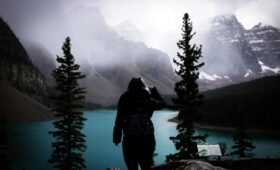
Moraine Lake and the Valley of the Ten Peaks appeared on the Canadian $20 banknote and is one of the most photographed landscapes on earth. The lake’s extraordinary blue-green colour against ten peaks exceeding 3,000 metres is almost unreal in good conditions. The Rockpile Trail — a 10-minute scramble up the boulders at the lake’s northern end — delivers the classic high viewpoint. Private vehicles are no longer permitted at Moraine Lake in peak season; access requires a shuttle reservation from Banff, Lake Louise village, or the Park & Ride.
The Valley of the Ten Peaks above vivid blue-green water, the Rockpile boulders as a foreground, and the glacier-carved valley stretching beyond
- Shuttle reservations are mandatory in peak season (late June–October) — book through Parks Canada weeks in advance
- Dawn is the most spectacular time — the peaks catch first light before the crowds arrive with morning shuttles
- Moraine Lake Lodge guests access the lake directly — expensive but crowd-free in peak season
- The lake is at its most vivid July–August when glacial melt volume is highest
Lake Louise Lakeshore & Plain of Six Glaciers
The most iconic lake in Canada · Victoria Glacier above · Château Lake Louise on the water’s edge
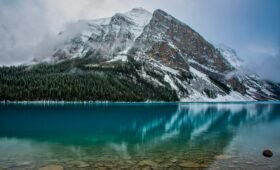
Lake Louise — its turquoise glacial water, the wall of Victoria Glacier, and the Château Lake Louise on the lakeshore — is one of the most recognisable landscapes on earth. The flat lakeshore walk from the Château to the far end and back delivers a continuously changing perspective. For an elevated view, the Plain of Six Glaciers Trail continues from the lakeshore to a teahouse at 2,185 metres, with a valley of glaciers opening dramatically as you climb. The lake is frozen November–May but equally beautiful, with ice skaters visible in winter from the Château terrace.
Victoria Glacier and the icefield above the lake, the Château reflected in the water, and the mountains of the Continental Divide to the west
- Arrive before 8am in summer — the parking lot fills fast and morning light on the Château is the best of the day
- The Plain of Six Glaciers Teahouse (open June–October) justifies the extra 2-hour return hike
- The lake is frozen November–May — equally beautiful in winter with far fewer visitors
- Canoe rentals at the boathouse in summer — being on the water gives an entirely different perspective
Mount Norquay Sightseeing Chairlift
Banff’s most underrated viewpoint · Different angle on the town · Less crowded than Sulphur Mountain
The Mount Norquay Sightseeing Chairlift is Banff’s most underrated viewpoint experience — a summer chairlift that lifts visitors above the treeline for excellent views over Banff townsite, the Bow Valley, and Mount Rundle from the north rather than the south. Less visited than Sulphur Mountain and significantly cheaper, it offers a different angle on the town and a better perspective of how Banff sits in the valley. The Cliffhouse Bistro built into the rock face at the top adds an excellent dining option with mountain scenery as a backdrop.
Banff townsite from the north, the Bow Valley stretching east and west, Mount Rundle from a different angle, and Cascade Mountain directly ahead
- A genuinely underrated alternative to the Banff Gondola — less crowded, different angle, and notably cheaper
- The Cliffhouse Bistro is built into the rock face — a lunch with this view is one of the most memorable in Banff
- Walk left after exiting the chairlift for the best chairs overlooking the mountain scenery
- Open summer only (approximately June–September) — check Mount Norquay website for current season dates
Cascade Ponds & Two Jack Lake
Cascade Mountain reflection in still water · Red chairs · Picnic area · Accessible and underrated
Cascade Ponds, just off the Minnewanka Loop road north of Banff townsite, is one of the most underrated viewpoints in the park. A picnic area with red Parks Canada chairs frames a direct view of Cascade Mountain reflected in the still pond water — the quintessential Canadian Rockies image accessible with zero hiking. Two Jack Lake, a short further drive, provides a similar viewpoint along the lake edge with Cascade Mountain dominating the north. Both are accessible year-round, significantly less crowded than the major Banff viewpoints, and combine well with the Lake Minnewanka Loop drive.
Cascade Mountain (2,998 m) reflected in still pond water, Castle Mountain to the west, and the surrounding Front Ranges of the Rockies
- Visit on a calm morning when the ponds are perfectly still — the Cascade Mountain reflection is the best available in Banff
- The red Parks Canada chairs are positioned for optimal views — sit, slow down, and look properly
- Combine with the full Lake Minnewanka Loop (24 km) for the most rewarding scenic circuit from Banff townsite
- Two Jack Lake and Johnson Lake further along the loop add variety without significant extra effort or time
Hoodoos Viewpoint
Ancient rock formations · Sleeping Buffalo Mountain silhouette · Bow Valley eastward view to Canmore
The Hoodoos Viewpoint, accessed from Tunnel Mountain Drive east of town, combines two distinctive views in one stop: the extraordinary hoodoo rock formations rising from the valley floor (protected by harder capstones from erosion below), and an expansive eastward view down the Bow Valley as far as Pigeon Mountain and Mount Lady Macdonald near Canmore. Looking the other way, Tunnel Mountain’s silhouette reveals why the Stoney Nakoda people called it Sleeping Buffalo — the mountain profile is unmistakable once you see it. A short interpretive trail provides context for both the geology and Indigenous history.
The Hoodoo formations, Tunnel Mountain’s Sleeping Buffalo silhouette, the Bow Valley stretching east toward Canmore, and the surrounding Front Ranges
- Visit in the evening — warm golden light on the hoodoos and the eastward valley view at sunset is one of the best free experiences in Banff
- Read the interpretive signs — the geology of the hoodoos and the Stoney Nakoda history are genuinely interesting
- Combine with Surprise Corner and Tunnel Mountain into a single Tunnel Mountain Drive circuit
- Accessible for families with young children — flat, paved, and no elevation gain required
Morant’s Curve — Bow Valley Parkway
World-famous railway curve · Canadian Pacific Railway · Mountains behind the tracks · A photographer’s pilgrimage
Morant’s Curve is one of the most photographed railway curves in the world — a Bow Valley Parkway pullout near Baker Creek where the Canadian Pacific Railway line curves against the backdrop of the Bow River and mountain peaks. Nicholas Morant, the CPR’s official photographer from the 1940s–1980s, immortalised this curve in hundreds of images and the spot was named in his honour. Catching a freight train passing through with the Rockies behind requires patience and luck, but the composition is compelling even without a train. A genuine piece of Canadian landscape photography history accessible from a roadside pullout.
The CPR railway curve with mountains and Bow River behind, and — when timing allows — a freight train completing the iconic composition
- Follow local photography social media groups — regular visitors track CPR train timings and share arrival windows
- Golden hour from the west (late afternoon) catches the mountains behind the curve most dramatically
- A brief, flat walk from the Bow Valley Parkway pullout — no hiking whatsoever required
- Combine with the Bow Valley Parkway wildlife drive at dawn or dusk for a full photography day
ALL 10 VIEWPOINTS AT A GLANCE
| # | Viewpoint | Effort | Cost | Best time |
|---|---|---|---|---|
| 01 | Sulphur Mountain Summit | Easy (gondola) or Strenuous | ~$70 gondola or free (hike) | Dawn or sunset, year-round |
| 02 | Tunnel Mountain Summit | Moderate, 1–2 hrs | Free | Sunrise, golden hour |
| 03 | Surprise Corner | None — roadside | Free | Dusk, blue hour |
| 04 | Peyto Lake — Bow Summit | Easy, 15-min walk | Free with pass | Before 8am, Jun–Sep |
| 05 | Moraine Lake Rockpile | Easy, 10-min scramble | Free (shuttle required) | Dawn, Jul–Aug |
| 06 | Lake Louise Lakeshore | Flat walk | Free with pass | Early morning, year-round |
| 07 | Mount Norquay Chairlift | Easy (chairlift) | ~$40 adult | Afternoon, Jun–Sep |
| 08 | Cascade Ponds | None — flat lakeside | Free with pass | Calm mornings, year-round |
| 09 | Hoodoos Viewpoint | Easy short walk | Free with pass | Evening golden hour |
| 10 | Morant’s Curve | None — roadside | Free with pass | Late afternoon light |
Banff is not short of views. It is short of the time most visitors give themselves to look at them properly. The most common mistake is moving too fast — arriving, photographing, and leaving before the light has changed or the crowd has cleared. The mountains reward patience more than any other quality. Find a red chair, sit in it, and look for longer than feels necessary. You won’t regret it.
Look up. Always look up · Banff National Park